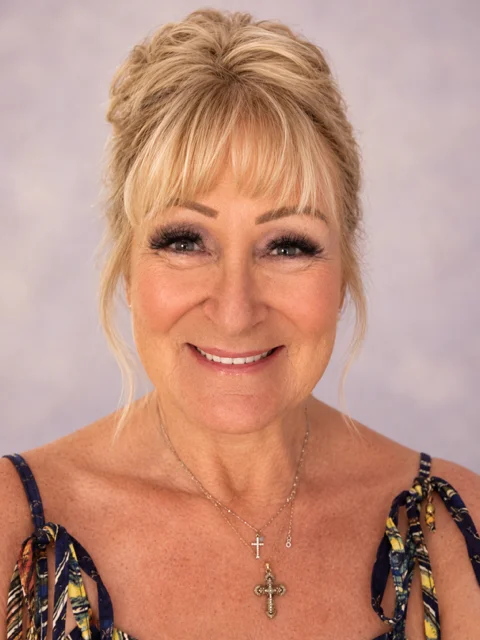

Hill Head's Eve Wilson, a retired headteacher in her 70s, taught herself AI to illustrate Bright Start, the reading books she first wrote for her grandchildren.
Eve Wilson spent more than 50 years in education, much of it teaching small children to read. Now in her 70s and living in Hill Head, she has taught herself to use AI to illustrate Bright Start, the reading scheme she first wrote for her own grandchildren.
She uses the tools for the pictures, for getting the files ready for a commercial printer, and for the animated clips she posts on TikTok and Instagram. The newest went up on Thursday.
“I am well into my 70s and have taught myself to use AI with confidence,” she told us.
“I can’t read!”
The books began with her granddaughter Honor. At five, Honor started coming home from school in tears every day.
“We were perplexed,” Eve writes in an account of the scheme she sent us. “Honor was a bright little girl and had actually started school already able to read.”
Eve and her daughter went to a parents’ evening about the school’s new phonics programme, THRASS. “As we listened, we could immediately see what was troubling Honor. She could already read the words. So why was she being asked to sound them out? I remember saying: ‘This is ridiculous. I’m going to teach her myself.’
“I couldn’t find a non-phonics reading scheme that reflected what I wanted for her, so I wrote one. Honor and her friends became the characters.”
Her grandson Henry, a couple of years younger, came next. “He was obviously very bright. I said, ‘Once he reads, he’ll be fine,’ and so I started including Henry in the books too. Before long, other grandchildren joined the stories, followed by their friends, and their friends’ friends.”
Honor and Henry are now 24 and 22. Eve says Honor has a First in philosophy and works in cyber security, and Henry has a First in maths and physics and is studying for an MSc.
From clip art to AI
For years the drawings held the books back. “At that time, all we had available to us was clip art,” she writes. “However hard we tried, the pictures were basic and uninspiring.”
The change came during Covid. Eve had set up a Christian shop on Etsy selling notebooks, cards and journals, and her daughter Charlotte suggested she try AI for some of the designs. “Suddenly, I could see a way of making my long-held dream a reality. Bright Start was born.”
In January this year she closed that shop, The Butterfly Effect, to work on Bright Start full time.
“It has been an extraordinary journey. There have been plenty of unforeseen problems, but also countless joyful discoveries,” she writes. “It has been a steep learning curve as I have grappled with several AI programmes. I use ChatGPT for the illustrations and Claude to check the copy and help prepare files to the size and resolution required for commercial printing.” The books are printed by Print Lover, and she says “the quality has been superb”.
The clip she sent us, made this week, walks through one of the stories, Effie’s Magical Adventure, a page at a time, then shows the scheme laid out in five stages, Foundation, Discovery, Achievement, Confidence and Independence, alongside an activity book, word jigsaws and flashcards. Henry and Honor appear in it as cartoon children.
A second clip, which she posted on TikTok over the weekend of 24 and 25 October, follows a little boy who stands at a bookshelf thinking “I wish I could read” until a grown-up sits down to share a book with him. It closes on the Bright Start Complete Set: graded reading books, five activity books, character cards and flashcards. Eve says it had 28,400 views within days. She makes the animations herself with ChatGPT and Canva’s animation tools.
42 six-year-olds and a piece of chalk
Eve’s first day in a classroom was in 1970. She had left school the previous August and was filling time in a tax office while waiting for a Civil Service post. “It was incredibly boring, so a friend persuaded me to become an unqualified ‘student teacher’.”
“On my first morning, I presented myself at the headteacher’s office. After a brief chat, she escorted me to a class of 42 six-year-olds. The teacher handed me a piece of chalk, said, ‘Playtime’s at 10.45,’ and then she and the headteacher left me to it. Sink or swim. I did more than swim. I absolutely loved it.”
She trained at Gipsy Hill College in Kingston upon Thames, taught a class of 42 in Colliers Wood, and later became a reception teacher in Milton Keynes. There she worked alongside a teacher called Pat Dawkins, who she says taught her the principles Bright Start still follows: “no capital letters except for names, minimal punctuation, a simple font that reflects children’s own writing, black ink, clear illustrations, repetition and, above all, success from the very beginning.”
Most of her career was in Northamptonshire. She was head of infants at a village school, took a first-class BEd focused on the early years, became headteacher at Sulgrave School and merged it with Culworth School. As an emergency headteacher she was sent into Croughton School, which she says was built for 78 children but had 31 when she arrived one January. By September there were 50, and when she left in 1998 the roll was 106. She was the reception teacher there too.
The workload took its toll. Eve writes openly that she had a major breakdown, spent four weeks in a psychiatric hospital and retired on ill-health grounds. She rebuilt her working life as an educational consultant and, with her second husband, set up Learn4Life, making teaching resources sold through Incentive Plus. Some are still in its catalogue, she says.
Success before sounds
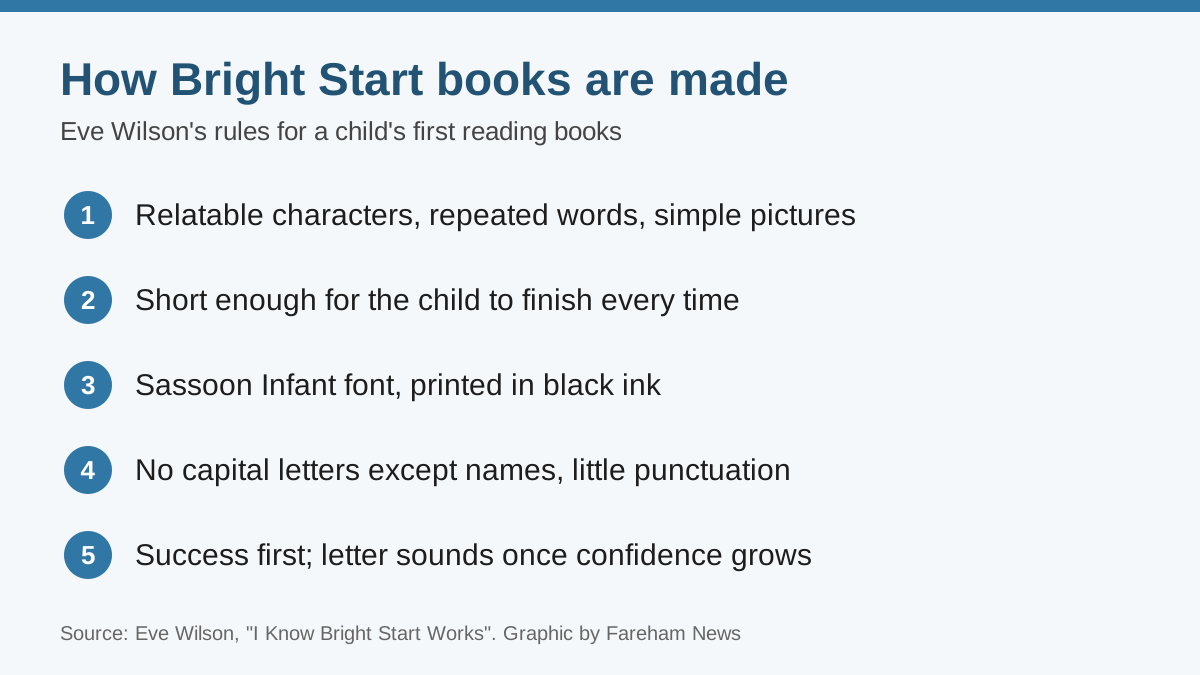
Her approach is simple, she says. “To start a child on their reading journey, give them a book with relatable characters, repetitive words and simple illustrations. Keep the book short enough for the child to finish it each time.” The books use the Sassoon Infant font in black ink, with no capitals except for names and as little punctuation as possible.
“A child who finishes a book and thinks, ‘I can read this,’ is a child who is much more likely to want to read another one.”
She is not against phonics. “I absolutely recognise that phonics has an important place in learning to read. My concern is with the idea that it should necessarily be the starting point for every child, regardless of what that child already knows.” Once a child’s confidence is growing, she says, the books start drawing attention to first letters and their sounds.
“I worry that when children who are already capable of recognising words are repeatedly required to sound them out, some can become frustrated and lose their enjoyment of reading.”
The scheme is aimed at very young children and at those who are struggling with phonics.
“I know Bright Start works,” she writes. “I have seen it work with my own grandchildren. I have seen it work with their friends. Bright Start is my attempt to give children another route into reading, one that begins with success, enjoyment and a love of books. I want children to discover that reading is something they can do, and something they want to do.”
What it means for you
Eve is putting together photographs of children using the books, and details of where families can buy them, to send us next week. We will add them to this page when they arrive.
Have your say