
Fareham's new Local Plan to 2044 is open for comment until 2 October, and the Call for Sites until 31 October. What the council's own evidence shows.
Fareham Borough Council has opened the first public consultation on a new Local Plan that will run to 2044. It closes on 2 October 2026. A separate Call for Sites, which invites anyone to nominate land for development or protection, stays open until 31 October.
The new plan will replace two documents at once: the Fareham Local Plan 2037 and The Welborne Plan, the standalone plan for the garden village north of the town. It will cover the whole borough and set the overall amount and distribution of new development, along with the site allocations and the policies used to decide planning applications.
Alongside the consultation the council has published a 42-page Baseline Data Assessment, dated August 2026. It is the evidence the plan will be built on, and it is worth reading before you comment. Some of what it records about the borough is not what you would expect.
What the council’s own evidence says
The report is a portrait of Fareham today, assembled from the census, the Land Registry, the business register and the council’s own monitoring. Five findings stand out.
The borough is barely growing, but it is ageing fast. The 2021 census put Fareham’s population at 114,513, against 111,581 in 2011, which the report rounds to a 3% rise over the decade. The council’s projection has it reaching 116,065 by 2047, an increase of roughly 1,550 people over 26 years. Inside that flat total, the shape changes sharply. Residents aged 24 and under are projected to fall from 28,438 in 2022 to 23,152 in 2047. Between the two censuses the number aged 65 and over had already risen from 22,776 to 28,100.
Almost half the borough’s workers no longer commute at all. At the 2021 census 48.7% of Fareham residents in work either worked mainly from home or had no fixed workplace, 27,119 people. That is the single largest group.
Two different figures are in play here, and the report uses both. The 27,119 counts home workers together with people who have no fixed workplace, such as tradespeople and drivers. The mode-of-travel table below counts only those working mainly at or from home, 19,206 people.
The full table, as published:
| Mode of travel to work | 2011 census | 2021 census |
|---|---|---|
| Work mainly at or from home | 5,726 | 19,206 |
| Driving a car or van | 38,218 | 28,382 |
| On foot | 3,696 | 2,838 |
| Passenger in a car or van | 2,586 | 1,744 |
| Bicycle | 2,061 | 1,200 |
| Other method of travel | 1,315 | 1,130 |
| Train, underground, metro, light rail or tram | 2,098 | 631 |
| Bus, minibus or coach | 1,074 | 501 |
The train figure is the one to watch. Fewer than 700 Fareham residents recorded a train as their main way of getting to work, down from more than 2,000 a decade earlier. The council’s separate rail chapter says passenger numbers at Fareham, Portchester and Swanwick stations have recovered strongly since 2020/21 and are approaching pre-pandemic levels, so leisure and off-peak travel appear to have come back where commuting has not.
Car ownership went the other way. Households with no car fell from 6,257 to 5,893, while households with three or more vehicles rose from 5,146 to 6,775.
Fareham is a bigger employment hub than its size suggests. About 18,150 people commute into the borough for work. Gosport and Portsmouth alone supply nearly half of them.
| Commuters travel to Fareham from | Number |
|---|---|
| Gosport | 5,461 |
| Portsmouth | 3,230 |
| Eastleigh | 1,625 |
| Southampton | 1,621 |
| Havant | 1,502 |
| Winchester | 1,357 |
| Elsewhere in Hampshire | 1,061 |
| Outside Hampshire | 2,290 |
Employment space is full, and shrinking. The council’s 2024 survey found 92% of employment units occupied, rising to 95% in the boatyard sector. At the same time the borough has been losing commercial floorspace. Over four years, gains of 8,170 square metres were outweighed by losses of 13,566, a net loss of 5,396 square metres. In 2024/25 alone, 9,167 square metres were lost against 518 gained. The report warns this “could have implications for the availability of business space and the area’s capacity to support economic growth”.
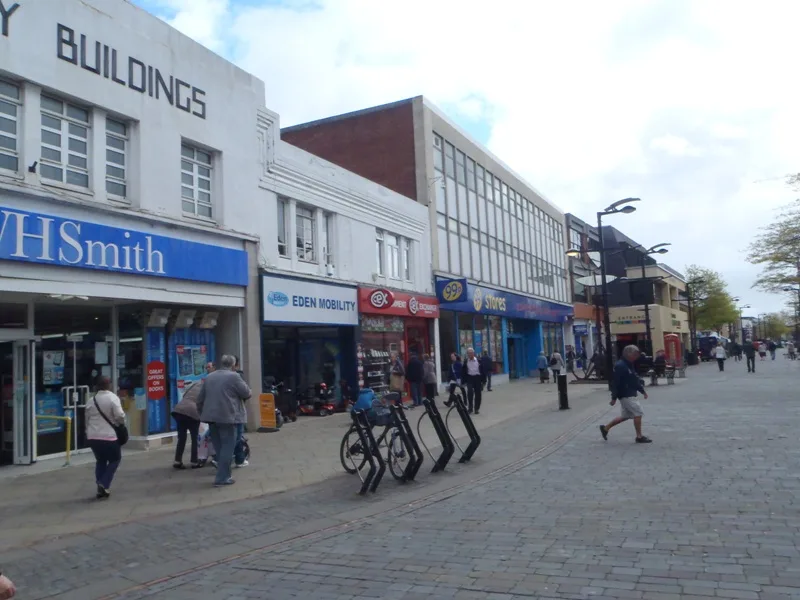
The town centre is fuller than it feels, but quieter. The summer 2025 survey recorded about 325 occupied units in Fareham town centre at roughly 90% occupancy, with low vacancy in the Portchester and Locks Heath district centres too. Footfall is the problem, not empty shops. The report describes a clear long-term decline from 2013 to 2020, a partial recovery after 2021, and levels that remain below pre-2016 figures, with growing reliance on Saturdays and event days.
Two other numbers are worth having when you comment. Approximately 9% of the borough’s land area sits in Flood Zones 2 and 3, with the risk coming from the sea and tidal estuaries rather than rivers. And average income per head after tax and benefits reached £25,716 in 2023, up from £15,323 in 2006, but still below the Hampshire and South East averages.
One caveat on the evidence base itself. The section on rail usage ends with a conclusion about shopping, services and leisure in “these centres”, which repeats the wording from the retail footfall section above it. If you are commenting on transport, read the rail figures rather than that paragraph.
What you are actually being asked
This is a scoping consultation, the first stage under the government’s new plan-making regulations. No decisions have been made about where development may take place. The council says it wants views on:
- what you value most about Fareham
- what concerns you about future change
- what improvements you would like to see
- how the borough can grow sustainably
- what priorities the Local Plan should focus on
Two other consultations are running alongside it and close on the same day. One is on the Draft Engagement Strategy, which sets out how the council will involve people at later stages. The other is the Strategic Environmental Assessment scoping consultation, on the environmental framework the plan will be tested against.
The council is blunt about the limits of the exercise. Its page states that it has “a legal requirement to plan positively for future housing, employment and infrastructure needs including national planning requirements on number of new houses needed”, while saying local input can influence where growth happens and what policies apply.
Councillor Malcolm Daniells, Executive Member for Planning and Development, said: “The new Local Plan will play an important role in shaping the future of Fareham, so we want as many people as possible to have their say at this early stage.”
The council is using AI to read your response
Buried on the consultation page is a disclosure most councils do not make. Fareham says it is using specialist planning software with AI-assisted features to handle the volume of responses. According to the council, the system is used to:
- analyse large volumes of consultation and consultee responses
- generate draft summaries of representations for officer review
- identify themes, trends and frequently raised issues
- carry out sentiment analysis, scoring views as positive, negative or neutral
- suggest keywords and topics for searching and reporting
- help officers spot information that may need redacting, such as personal details
The council states that all AI-generated summaries and tags are reviewed and, where necessary, amended by officers, and that “AI does not make any decisions”. It says the approach helps it meet the statutory timescales while still giving proper consideration to feedback.
That matters for how you write your response. A short, clear, specific comment is easier for both an officer and a summarising tool to categorise correctly than a long one covering several unrelated points.
The Call for Sites: anyone can nominate land
The Call for Sites is open until 31 October 2026 and is not limited to developers. The council invites submissions from landowners, agents, businesses, organisations and members of the public, for uses including housing, employment, community facilities, renewable energy, open space, recreation, biodiversity enhancement and environmental conservation.
Submitting a site does not mean it will be allocated, and the council says it does not indicate support for development there. Sites are assessed against planning policy, environmental constraints, access and transport, infrastructure capacity, deliverability and viability, and impacts on communities and the environment. The assessments will be published as part of the evidence base.
The timetable: adoption in 2029
The government brought the Town and Country Planning (Local Planning) (England) Regulations 2026 into force in March 2026, imposing a 30-month plan-making timetable with fixed “gateway” checkpoints. Fareham’s published timetable took effect on 26 June 2026.
| Stage | Date |
|---|---|
| Scoping consultation | 24 Aug to 2 Oct 2026 |
| Gateway 1 decision to progress | by 31 Oct 2026 |
| Consultation on proposed plan content and evidence | 7 Jun to 16 Jul 2027 |
| Gateway 2 decision to progress | 13 Dec 2027 to 21 Jan 2028 |
| Consultation on the proposed draft Local Plan | 7 Feb to 31 Mar 2028 |
| Gateway 3 decision to progress | 31 Jul to 29 Sep 2028 |
| Submission | 27 Oct 2028 |
| Independent examination | 30 Oct 2028 to 27 Apr 2029 |
| Adoption | expected by 31 May 2029 |
The council is required to review that timetable monthly and publish any amendments.
What it means for you
- If you want a say on where Fareham builds, this is the stage to take it. Once the plan reaches the draft stage in February 2028, the sites will already be chosen.
- The deadline for the scoping consultation is Friday 2 October 2026. Respond online through the council’s consultation portal, or ask the Planning Strategy Team for another way in on 01329 824601 or at planningpolicy@fareham.gov.uk.
- Hard copies are in every borough library and can be viewed on request at the Civic Offices in Fareham town centre, if you would rather read on paper or reply on a form.
- If you own or know of land you think should be built on, or protected, you can nominate it until 31 October. You do not have to be a developer.
- Keep your response short and specific. The council is running responses through AI-assisted summarising software before officers review them.
- Read the Baseline Data Assessment first if you have the time. It is the evidence the whole plan rests on, and it is the document that will be quoted back at objectors for the next three years.
More Fareham local information: planning news, house prices, council tax bands, roadworks and travel and bin collection days.
Sources
- New Local Plan, Fareham Borough Council and its Have Your Say page, which carries the AI disclosure quoted above.
- Local Plan Scoping Consultation for the consultation dates, the questions asked and the contact details.
- Baseline Data Assessment, August 2026 (PDF) for the population, commuting, car ownership, employment land, retail occupancy, footfall, flood risk and income figures. Tables 10, 12 and 13 are the source of the travel and commuting numbers.
- Local Plan Timetable for the stages, dates and the plan period to 2044.
- Call for Sites for the 31 October deadline and the assessment criteria.
- Residents and businesses invited to help shape Fareham’s new Local Plan, Fareham Borough Council press release, 24 August 2026 for the councillor’s quote.
Have your say